
Most firm owners assume a server outage is an inconvenience.
Until it happens.
One minute, employees are working normally. The next, nobody can access files, accounting software won't open, emails stop syncing, and every phone call starts with, "I can't get into the system."
The bigger question isn't whether your server could go down, but….
What happens to your firm if it does?
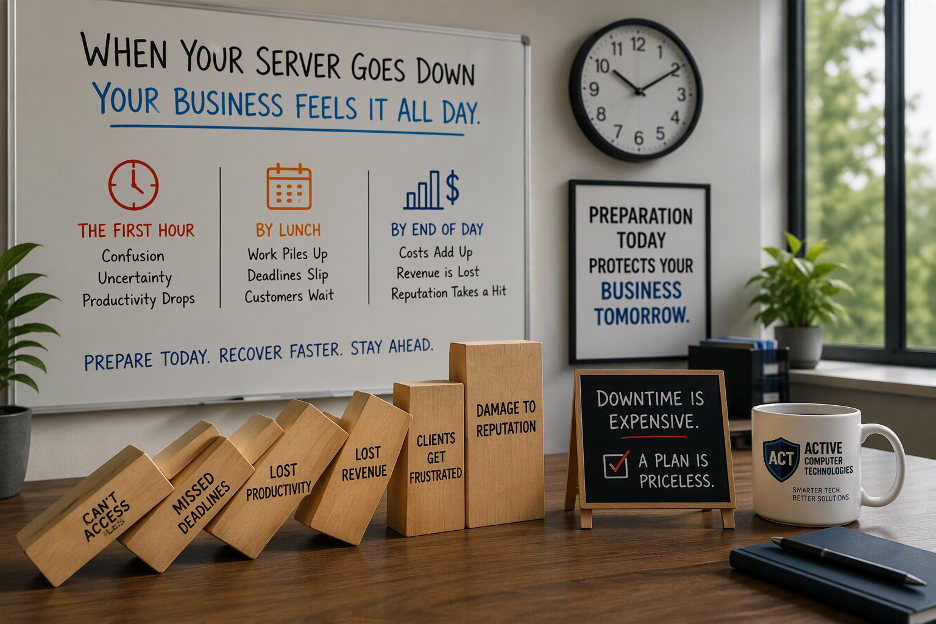
The First Hour: Confusion Sets In
The first hour usually isn't spent fixing the problem.
It's spent figuring out what happened.
Employees call each other asking if they're having the same issue. Managers try to determine whether it's the internet, the server, a power outage, or a cybersecurity incident. Clients start waiting on responses. Work slows to a crawl.
During this stage, productivity drops immediately because nobody knows what systems are available and which are not.
By Lunch: Work Starts Piling Up
Now imagine the outage lasts several hours.
Your team can't access shared files. Quotes can't be generated. Invoices can't be processed. Client information becomes unavailable. Employees begin finding ways to work around the problem, often creating more issues in the process.
For law firms, case documents may be inaccessible.
For accounting firms, tax returns and financial records may be unavailable.
For manufacturers, production schedules can stall.
Even firms that rely heavily on cloud applications often discover that critical files, databases, or authentication systems still depend on servers somewhere in the background.
By the End of the Day: The Costs Start Adding Up
Most firms calculate the cost of downtime based on lost revenue.
That's only part of the equation.
A server outage can also lead to:
- Employees being paid while unable to work
- Missed deadlines
- Delayed customer responses
- Lost sales opportunities
- Trouble with case documents
- Overtime expenses needed to catch up
- Damage to customer confidence
If a 25-person firm or business averages $35 per hour in labor costs, even a single day of downtime can quickly add up to over $7,000 dollars in lost productivity alone with that conservative scenario.
Firm owners often ask whether managed IT services are worth the cost.
Here's another question: What's one day of downtime worth to your business?
If your team can't work, your clients can't get answers, and your revenue-generating systems are unavailable, the financial impact adds up quickly. In many cases, the cost of a single outage can outweigh several months of managed IT services, which for most of our clients ranges from $165 to $185 per workstation per month. So IT costs for the entire month for a 25-person firm are more than covered by preventing one down day – most owners would call that worth it!
That's why the conversation shouldn't just be about the cost of IT support. It should also be about the cost of NOT having solid IT support or not having it at all and hoping for the best.
The downtime is just the beginning of the expense – now include the cost of recovering the system.
The Real Question: How Quickly Can You Recover?
When we talk to firms about disaster recovery, many immediately ask:
"How can we prevent outages?"
It's a fair question.
But no technology is perfect.
Hardware fails. Power outages happen. Human error occurs. Cybercriminals target businesses every day.
A better question is:
How quickly can you get back to work when something goes wrong?
Resilience is a key part of successful firms because, yes, something went wrong… but how can you fix it quickly, keep it fixed and then go straight back to work?
The answer is simple. MONITOR!!
The firms that recover fast typically have:
- Verified backups
- Written recovery procedures
- Redundant systems
- Clearly assigned responsibilities
- Regular recovery testing
They aren't scrambling to figure out what to do because they've already rehearsed the process.
If you have read or just glanced at any of our other blogs, you'll notice that we emphasize keeping up with recoveries, backups, etc. Staying ahead of problems is the KEY to success!
The Biggest Mistake We See
Many firms believe they're protected because they receive backup reports showing successful backup jobs.
The problem?
A successful backup doesn't guarantee a successful recovery.
We've seen firms discover corrupted backups, missing files, and failed recovery processes only after an outage had already occurred.
In Texas, severe storms, utility disruptions, and extreme weather can impact businesses with little warning. When that happens, companies without a secure recovery plan often discover just how dependent they are on a single server. We believe in multiple backup plans and have used them to recover some of our clients after tornados struck during the night and we had them working remotely, safely the same day – actually within hours.
That's why backup testing is just as important as having backups in the first place.
A backup is only valuable if it can be restored.
Could Your Firm Survive a Day Without Its Server?
Most organizations don't know the answer until they're forced to find out.
If your server went offline today, could your team continue operating?
How long would it take to restore critical systems?
Who would be responsible for leading the recovery effort?
If you're unsure about any of these, now is the time to find out… and quickly. Because the worst day to build a recovery plan is the day you need one.
Get help evaluating your backups, disaster recovery plan, or server infrastructure, Active Computer Technologies can help identify gaps before an outage turns into a business crisis. Just like in the medical world, a second opinion is an excellent idea to see how healthy you really are.
Book a 15-minute discovery call at 469-653-0517 or visit www.activecomputers.com. We are here to serve!